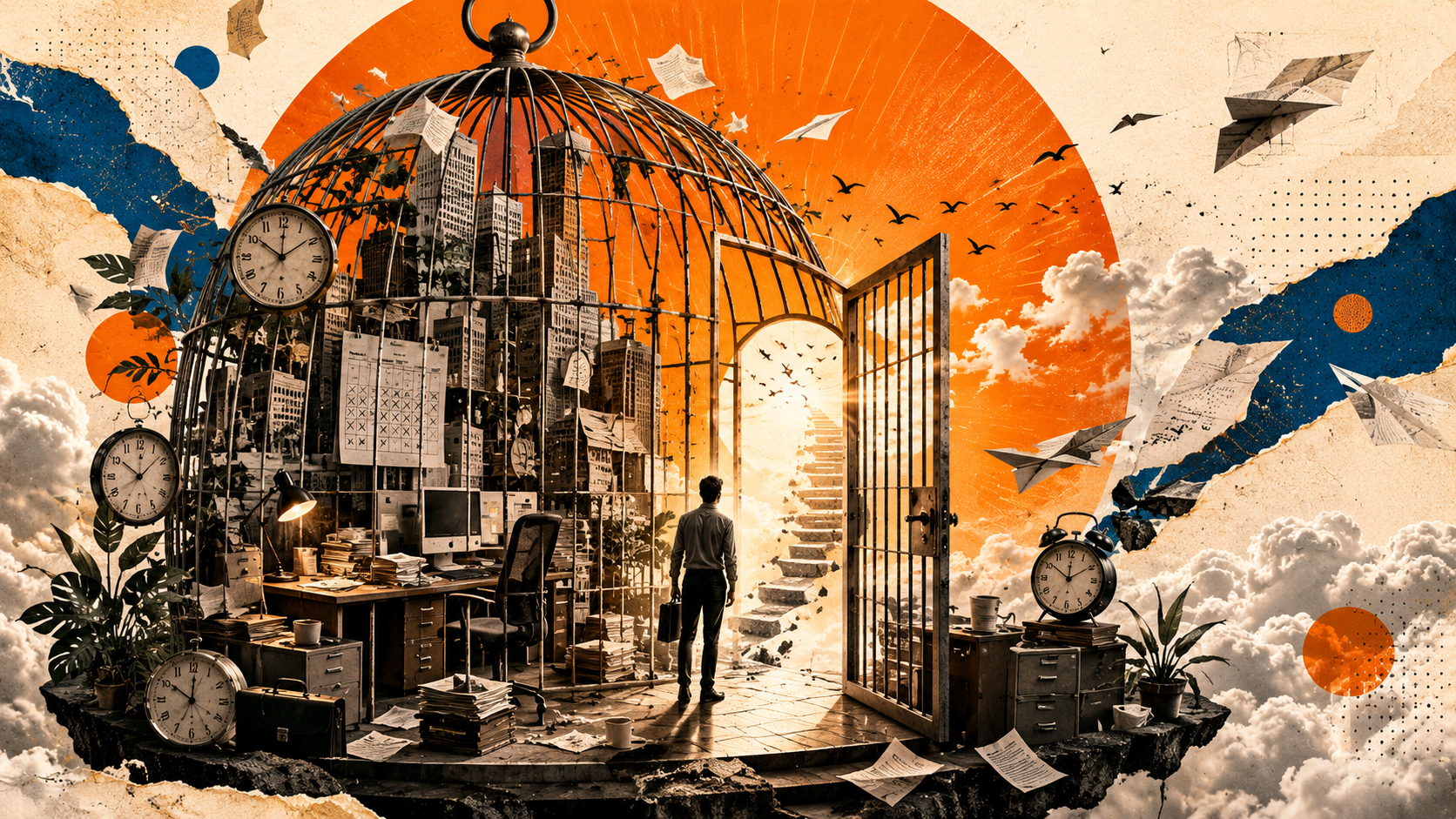
“Many people feel that staying in the 9-to-5 cycle is safe, but in reality, it can become a comfortable trap that keeps us from moving forward. In this article, we will explore why most people get stuck in this loop and discuss practical ways to finally break free from it.“
📖 What You’ll Learn 9-to-5
The biggest challenge of the 9-to-5 cycle is that it feels safe enough to stay.
A few weeks ago, I caught myself doing something I’ve probably done hundreds of times before.
I came home from work, put my bag down, took a shower, opened my phone, and somehow, two hours disappeared.
Nothing unusual.
In fact, that’s probably what millions of people are doing right now.
Wake up. Go to work. Come home. Scroll. Sleep. Repeat.
The strange thing is that most people already know what they want.
More freedom. More money. Less stress. More control over their time.
Yet somehow, years go by and nothing really changes.
For a long time, I assumed the answer was simple.
Maybe people weren’t disciplined enough.
Maybe they were lazy.
Maybe they didn’t want success badly enough.
But the more I read about psychology, behavior, and successful entrepreneurs, the more I realized something uncomfortable.
Some of the smartest people studying human behavior don’t think laziness is the problem at all.

Why Hard Work Doesn’t Always Lead to Financial Freedom
One psychologist who changed the way I think about this topic is Martin Seligman.
Seligman became famous for developing a theory called learned helplessness.
The idea is surprisingly simple.
When people repeatedly experience situations where effort doesn’t seem to change the outcome, they eventually stop trying.
Not because they’re incapable.
Because their brain begins to believe that trying doesn’t matter.
And honestly, that sounds a lot like modern 9-to-5 working life.
Think about how many people have tried to improve their situation before.
They started a business. It failed.
They tried investing. They lost money.
They started a YouTube channel. Nobody watched.
They launched a blog. Nobody read it.
After enough disappointments, many people stop believing that effort can change anything.
The paycheck might not be exciting, but it feels safe, predictable, and certain.
And certainty is incredibly powerful.
The Trap Most People Don’t Notice
I think one of the biggest reasons people stay in the 9-to-5 cycle is because the system itself works.
Not perfectly but well enough.
Your salary arrives every month. The bills get paid. Food stays on the table. Life moves forward. Nothing feels urgent enough to force change.
That’s what makes the cycle difficult to escape.
You’re not miserable enough to leave but you’re not fulfilled enough to stay forever.
You simply exist somewhere in the middle.
And before you know it, another year has passed.
Then another.
Then another.
The Problem Isn’t Goals. It’s Systems.
A few years ago, I read Atomic Habits by James Clear.
One idea from the book stayed with me.
“You do not rise to the level of your goals. You fall to the level of your systems.”
At first, it sounds like another motivational quote.
But the more I thought about it, the more it made sense.
Most people have goals.
Financial freedom. Starting a business. Building a second income stream. Creating more options for themselves.
The problem is that goals don’t determine outcomes. Systems do.
If your daily 9-to-5 system is: Work.
Come home.
Scroll social media.
Sleep.
Then that’s exactly where you’ll be next year.
Not because you’re lazy, because your system is producing predictable results.
And most people don’t even realize they’re following a system.

Not Everyone Can Take The Same Risk
One thing that bothers me about a lot of online business advice is how casually people talk about risk.
“Just quit your job.”
“Start a business.”
“Take the leap.”
It sounds inspiring.
Until you realize that not everyone is standing at the same starting line.
A 22-year-old living with their parents can take risks that a father supporting two children simply can’t.
Someone with six months of savings can make decisions that someone living paycheck-to-paycheck might never consider.
Someone with no debt faces a completely different reality from someone carrying financial responsibilities every month.
The reality is that people have different obligations, different responsibilities, and different levels of risk tolerance.
And that’s okay.
I don’t think escaping the 9-to-5 requires reckless decisions.
In fact, I think the internet has made it possible to do the opposite.
Instead of jumping, many people can build.
Slowly.
After work.
On weekends.
One hour at a time.
A blog.
A skill.
A side project.
A second income stream.
The goal isn’t necessarily to quit your job tomorrow. The goal is to reduce dependency on a single source of income over time. Because freedom isn’t always created by taking bigger risks.
Sometimes it’s created by taking smaller risks consistently for years.
Why One Hour a Day Matters More Than You Think
Whenever people talk about escaping the 9-to-5 or creating another source of income, the first thing they usually say is:
“I don’t have time.”
And honestly, I understand.
Life gets busy. Work gets exhausting. Responsibilities pile up.
But let’s look at the math.
One hour per day doesn’t sound like much.
Yet over a year, that’s 365 hours.
That’s more than nine full-time work weeks.
Imagine spending those hours learning a skill, writing articles, building a website, creating digital products, learning marketing, or simply reading books that make you think differently.
Nobody becomes successful in one hour.
- But almost every successful person accumulated thousands of hours somewhere.
The difference is that they started before they felt ready.

Why Small Actions Create Massive Results
Another idea that repeatedly appears in personal development comes from The Compound Effect by Darren Hardy.
The entire premise of the book is that small actions repeated consistently create extraordinary results over time.
Most people understand compounding when it comes to money. Few people recognize compounding in skills, knowledge, and businesses.
- Writing one article won’t change your life. Writing 300 articles might.
- Creating one video won’t change your future. Creating 500 videos might.
- Learning for one hour doesn’t matter. Learning for 1,000 hours does.
The challenge is that compounding is invisible in the beginning.
That’s exactly why most people quit.
Case Study #1: Nathan Barry
Before founding ConvertKit, Nathan Barry spent years writing books, publishing content, and building an audience.
There was no overnight success.
There was no viral moment that instantly changed everything.
Instead, he consistently created valuable content and gradually built trust with readers.
Eventually, that audience became the foundation for a company worth millions.
What stands out isn’t the money.
It’s the timeline.
“Most people would have quit long before seeing results.”
Case Study #2: Ali Abdaal
When people look at Ali Abdaal today, they see millions of subscribers, courses, sponsorships, and businesses.
What they don’t see are the years when almost nobody was watching.
His early videos received very little attention.
He spent years publishing content before the internet noticed him.
The lesson isn’t that everyone should become a YouTuber.
The lesson is that consistency often matters more than talent.
Case Study #3: James Clear
Before James Clear became one of the most recognized writers in personal development, he spent years publishing articles on his website.
One article.
Then another.
Then another.
Long before Atomic Habits became a global bestseller, he was already building an asset: an audience.
The book wasn’t the beginning.
It was the result of years of consistent work.
Alright look,
I don’t think the goal is to quit your 9-to-5 job next month, become rich overnight, or take reckless risks. And I definitely don’t think everyone should take the same risks.
The goal is to create options.
To build something.
To learn something.
To invest time in a future version of yourself.
Because five years from now, you’ll either have five years of excuses or five years of progress.
And while neither path guarantees success, only one of them gives you a chance to escape the cycle.
Maybe that’s the real difference between the people who stay stuck and the people who eventually create more freedom.
But knowing you need a change and knowing where to start are two very different things.
One path more people are exploring today is digital products.
Not because it’s easy.
Because unlike traditional side hustles, you’re building something that can continue working long after you’ve created it.
If you’re curious why digital products have become so popular, I wrote more about it here:
👉 Why Selling Digital Products Could Be the Smartest Side Hustle in 2026
Leave a Reply