 Faris
Faris
What You’ll Learn
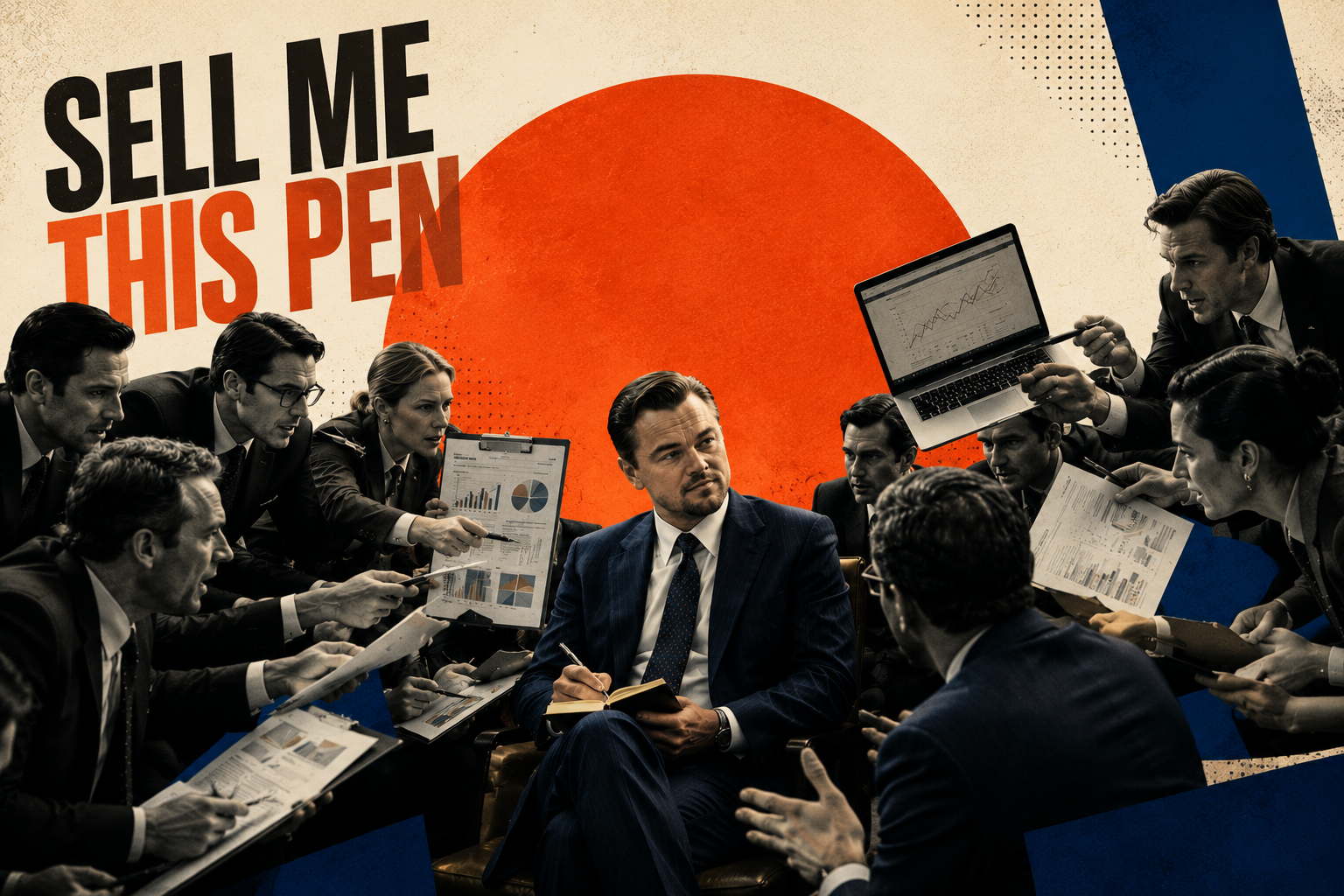
If you’ve ever watched The Wolf of Wall Street, you definitely remember the iconic scene where Jordan Belfort challenges a room full of people with the famous “Sell Me This Pen” challenge. He tests them with four simple words:
“Sell me this pen.”
Leonardo DiCaprio
Most people think this classic interview trick is about being a smooth talker, a charismatic hustler, or a master of aggressive persuasion. They picture a high-energy salesperson suffocating a client with fast-paced pitch lines until they finally cave in and buy.
But here at ClockOut, we look at things differently. If your ultimate goal is to transition into freelancing, build a location-independent business, or design a lifestyle of true autonomy, this question isn’t about selling stationery at all. It is actually the ultimate blueprint for your professional freedom. And it all boils down to one severely underrated asset: Active Listening and Market Diagnostics.
The Toxic Cycle of the “Feature Shouter”
When people decide they want to break away from standard employment, they usually bring their old habits with them. They take their “pen” their raw labor, whether it’s coding, copywriting, SEO strategy, or graphic designnand they immediately start shouting about its features to anyone who will listen:
“I have 5 years of experience in full-stack development!”
“My designs are modern, minimalist, and aesthetic!”
“I can write 3,000 words of SEO-optimized content a day!”
By doing this, you are treating yourself like an employee looking for a boss, rather than an independent creator looking for a partner. You are trying to convince the client how great your “pen” is before knowing if they even have a reason to write.
The result? You attract micromanagers, get stuck in endless revision loops, and end up trading a standard office schedule for a 24/7 digital prison.
The ClockOut Shift: Diagnosing to Protect Your Freedom
To successfully build a career where you dictate your hours and your location, you have to realize that high-paying, respectful clients do not care about your technical features. They care about their own problems.
A great independent professional views a discovery call exactly like a doctor views a checkup. A doctor doesn’t walk into the room and immediately pitch you on a specific surgery. They sit down and ask: “Where does it hurt?”
When you shift from a “pitcher” to a “diagnostician,” your entire relationship with work changes. Here is how that psychological shift protects your freedom:
1. The Inception Effect: Letting the Client Sell to Themselves
In Christopher Nolan’s film Inception, Cobb explains that
the most resilient idea is one that grows naturally from within the mind, not one forced upon it from the outside.
The same rule applies to professional freedom.
When you use the “Sell Me This Pen” approach, you aren’t trying to force your services down a client’s throat. Instead, by asking sharp, targeted questions
“What happens to your revenue if this system stays broken for another six months?”,
you let the client articulate their own pain. You are planting the seed. By the end of the conversation, they aren’t feeling pressured by a salesman; they are practically begging you for the solution. You don’t close them, they close themselves.
2. Filtering Out Toxic Clients (Before They Trap You)
When you stop pitching and start diagnosing, you immediately see behind the curtain. If a client can’t explain their goals, blames past freelancers for all their failures, or expects you to solve vague problems with zero budget, you drop the pen and walk away.
As Greg McKeown writes in his bestselling book, Essentialism: The Disciplined Pursuit of Less, “If it’s not an absolute YES, then it’s a NO.” True freedom isn’t just about having the liberty to work from anywhere; it’s having the power to say no to bad money and toxic energy that will drain your time.
3. Breaking the “Hourly Rate” Trap via Value Economics
When you sell your features or your hours, you are viewed as an exchangeable cog. The client tracks your time, watches your screen, and controls your day—the exact opposite of the independent lifestyle.
But when you diagnose a massive business bottleneck, you can charge flat, value-based project rates. If a company is losing $50,000 a month due to a broken system, and you can fix it in 5 hours because you listened closely and diagnosed it perfectly, you shouldn’t be paid for 5 hours of labor. You should be paid for the massive value you unlocked. This is how you shift from trading time for money to trading outcomes for money, giving you the financial runway to work less and live more.
The ClockOut Takeaway: Your Next Steps to Freedom
You don’t need to be an aggressive, loud, Wall-Street-style hustler to gain your independence. In fact, real autonomy belongs to the quietest people in the room, the ones who listen closely enough to understand what people actually need, diagnose the pain, and offer the exact solution.
If you’re ready to stop pitching like a desperate service provider and start operating like a high-leverage consultant, here is your action plan:
📚 One Book Worth Reading
If this idea resonates with you, one book that genuinely changed how I think about conversations is Never Split the Difference by Chris Voss.
Voss spent years negotiating international hostage situations for the FBI. Surprisingly, the lessons have very little to do with negotiation itself. They’re about listening well enough to understand what people actually need before trying to solve anything.
Whether you’re freelancing, interviewing for a job, selling a service, or simply trying to build better relationships, the book offers practical techniques that make people feel heard instead of persuaded.
. …. ..
You know what… Learning to listen is valuable, but it’s part of a much bigger skill.
The people who build careers outside the traditional 9-to-5 aren’t usually the loudest or the smartest person in the room. They’re often the ones who learn quickly, understand problems deeply, and communicate clearly.
If you’re interested in that idea, you might also enjoy reading The Skill That Makes Every Other Skill More Valuable, where we explore why learning itself is one of the highest-return investments you can make.
— Admin
This article was drafted with the assistance of AI, but 100% reviewed and refined by a human.
Leave a Reply